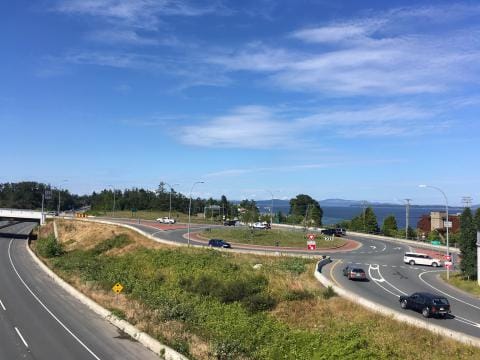
How to Use
Refer to the ICBC resources linked below:
Refer to the ICBC resources on the Town's Roundabouts webpage.
Below is a basic summary for motorists.
- Before entering, look left and yield to all oncoming traffic in the roundabout and any pedestrians/cyclists in the crosswalk,
- when entering, continue moving counter-clockwise and to the right of the rotary traffic island,
- while in the roundabout,
- do not pull over
- do not stop unless required due to traffic congestion
- if you hear an emergency vehicle, do not stop or pull over - continue through your intended exit and then pull over
- do not pass a cyclist - cyclists may choose to enter the roundabout and follow the same rules and procedures as a motorist - see the Cyclists section on this webpage to learn more
- give large trucks lots of room to travel - roundabouts have what is called an “apron” encircling the centre island - this raised, coloured section allows longer, wider vehicles extra clearance when needed
- as you approach your exit, activate your right turn signal so pedestrians, cyclists and other drivers know your intentions - yield to any pedestrians/cyclists in the crosswalk.
Image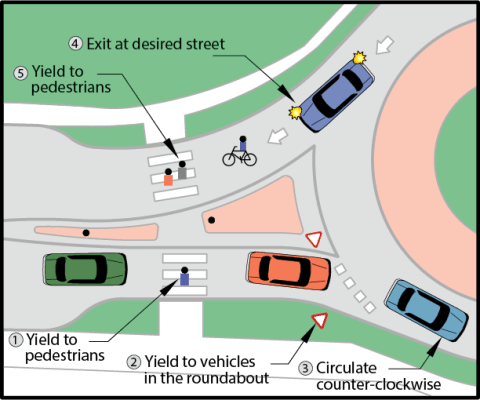
Refer to the ICBC resources on the Town's Roundabouts webpage.
Below is a basic summary for cyclists.
Cyclists have a couple of choices when it comes to roundabouts...
Enter the roundabout like a vehicle
Experienced cyclists may follow the same rules and procedure as motorists. Approach roundabouts cautiously. In advance of the roundabout, hand signal and merge with traffic when safe to do so. Occupy the traffic lane and proceed into the roundabout as a vehicle would. Stay in the middle of the lane - don’t hug the curb. Since traffic is slower inside the roundabout, you should be able to travel at the same speed as other vehicles. Watch out for driver’s blind spots. Do not stop unless required due to traffic congestion. Be aware of and yield to pedestrians/cyclists on the crosswalk when exiting a circle.
Or,
Use the pathway and crosswalk, based on the two designs below
- Comox Ave/Glacier View Dr roundabout and the Comox Ave/Rodello St roundabout are both designed with crosswalks that have "elephant's feet” markings (as indicated by the dots on the crosswalk image below). This design allows cyclists to stay on their bicycles and ride through the pathway and marked crosswalks. Be mindful that you’re sharing the pathway and crosswalk with pedestrians. Do not enter the crosswalk unless there’s an adequate gap in traffic or all approaching vehicles have stopped. Only cross the roundabout through the crosswalks, never through the centre island. Learn more: When a cyclist rides in a crosswalk. Note, Comox Ave/Glacier View Dr has a wayfinding sign to direct cyclists to the crosswalk at the east side of Aitken Street to cross Comox Ave, rather than crossing at the top of Comox Hill. This is due to sightline limitations for vehicles travelling up Comox Hill.
Image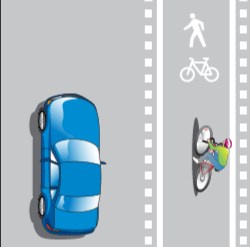
Elephant's Feet are indicated by dots alongside the crosswalk. - Pritchard Rd/Knight Rd roundabout is designed with crosswalks that do not have "elephant's feet” markings therefore, cyclists are required to dismount their bicycles and use the crosswalks as a pedestrian. Do not enter the crosswalk unless there’s an adequate gap in traffic or all approaching vehicles have stopped. Only cross the roundabout through the crosswalks, never through the centre island. Be mindful that you’re sharing the pathway and crosswalk with pedestrians.
Refer to the ICBC resources on the Town's Roundabouts webpage.
Below areis a basic summary for pedestrians.
Pedestrian crosswalks with pavement markings are located about one car length away from the roundabout. Only cross the roundabout through the marked crosswalks, never through the centre island.
Although vehicles are required to yield to pedestrians, you shouldn’t initiate a crossing unless there’s an adequate gap in traffic or all approaching vehicles have stopped.
Be aware that you may be sharing a pathway and crosswalk with cyclists - the COMOX AVENUE roundabout crosswalks have "elephant's feet” markings which allows cyclists to stay on their bicycles and ride through the pathway and marked crosswalks - see the Cyclists section on this webpage to learn more.
Comox Avenue
Due to high volumes of traffic on Comox Ave, it is difficult for traffic on Glacier View and Aitken to turn onto Comox Ave. As traffic volumes increase into the future, this problem will continue to get worse. The Town’s 2011 Transportation Study recommended that a roundabout be installed to address the traffic
issues. This recommendation was reaffirmed as part of the Town’s 2020 Transportation Master Plan Update. Please review the Transportation Master Plan Update for more information. More information on this roundabout project can be located here.Due to high volumes of traffic on Comox Ave, vehicles moving north and south at this intersection are seeing long wait times to be able to turn onto Comox Ave in any direction. The new roundabout will help cars move optimally in all directions and decrease wait times at the intersection. This is especially important as the area is expected to see additional development into the future. The Town’s 2020 Traffic Master Plan Update recommended that a roundabout be installed at Rodello and Comox to address the traffic concerns. The Town confirmed this recommendation through an independent investigation of the intersection. This report can be found at here.
The roundabouts were identified in the Town’s 2011 Transportation Master Plan. Both the Glacier View Dr. and Rodello St. intersections were identified as having a limited or failing level of service. This evaluation was reconfirmed in that traffic management study updated in 2020. There is about a 500-metre separation between the two roundabouts and each one will support separate neigbourhood concerns.
The Town will be using development cost charges to fund the roundabout at Rodello. The Glacier View Dr. roundabout is smaller and development cost charges will not be used.
Additional Information
A roundabout is a circular intersection designed to manage traffic in a simple and effective manner. Vehicles move in a counter-clockwise motion around a central island, and entering vehicles must yield to all traffic already in the roundabout.
Roundabouts are a safer alternative to traffic signals and stop signs. The tight circle of a roundabout forces drivers to slow down, and the most severe types of intersection crashes — right-angle, left-turn and head-on collisions — are unlikely.
Roundabouts improve traffic flow and are better for the environment. Research shows that traffic flow improves after traditional intersections are converted to roundabouts. Less idling reduces vehicle emissions and fuel consumption.
Roundabouts generally are safer for pedestrians. Pedestrians walk on sidewalks around the perimeter and cross only one direction of traffic at a time. Crossing distances are relatively short, and traffic speeds are lower than at traditional intersections.
While circular intersections (rotaries) existed in North America since the early 1900s, the modern roundabout was born out of the United Kingdom in the 1960s, before emerging in Canada in the 1990s.
One of the first modern roundabouts built on a provincial road in BC is the double roundabout on Eighth Avenue, just off Highway 99 and west of Highway 15, near the US border. This location, which opened in 2005, features two roundabouts on either side of the interchange.
In 2011, one of BC’s largest networks of roundabouts opened to traffic on Highway 17 at McTavish Road just south of Sidney. Previously a signalized intersection, a combination of three roundabouts improved traffic flow to and from the Victoria International Airport, the Swartz Bay ferry terminal, and the rest of the Saanich Peninsula. The roundabout network also incorporates a six-bay transit exchange and a 200-stall park and ride lot.
Some more examples of roundabouts include:
- Highway 1 at McCallum Road in Abbotsford – two multi-lane roundabouts and a four-lane overpass replaced the two-lane bridge over the Trans-Canada Highway, improving access to and from the city. Work was completed in 2011.
- Highway 97 six-laning project in Kelowna – a roundabout was used on the side road realignment at Rutland/Old Vernon to improve access and keep traffic moving through the area. Work was completed in 2018.
- Highway 16/37 near Terrace – construction of a roundabout to replace the existing four-way stop.
- Highway 93/95 in Radium Hot Springs – the current four-way stop results in heavy backups, especially during the peak summer months.
Image